
From a “Plan” to “Planning”
For some, Strategic Planning is all about creating “the Plan”. In that mindset, there is a lot of focus on the document, and how to be sure it is all-encompassing and yet easily understood. However I've come to view “the Plan” as only the midpoint of the ongoing “process of planning”. And I've seen organizations thrive when they move beyond creating a great Plan to embracing planning as another ongoing management discipline just like finance, human resources, or supply chain management.
It's about the Process In this view, there is a lot of important work leading up to the creation of the plan document. I refer to that work as inputs. And, many plans specify subsequent work that needs to be done if vision or goals are to be realized, which I refer to collectively as outputs. Because we operate in a world of change, some aspects of this work should be continuous, not sporadic. Organizations that embrace this ongoing, broader view are much more likely to realize success from their plan.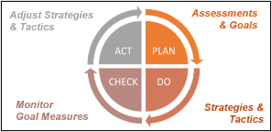
Strategic Plans represent an organization’s desire for growth, sustainability, and measurable success…in essence, to improve. Perhaps that is why I’ve been so drawn to understanding Strategic Planning as a process, for at the core of continuous process improvement we have the Plan-Do-Check-Act (PDCA) or Shewhart Cycle (see middle of diagram at right). Working in both Strategic Planning and Process Improvement, this similarity has always been very compelling to me.
Data Informed Planning Those inputs leading up to creating the plan include a great deal of data collection and analysis eventually taking the form of three assessments: Industry, Market, and Organization. Compiling these assessments often entails primary and secondary research, customer and stakeholder feedback, and sometimes highly structured needs assessments. Much of this work is about surveillance and listening, which, in a world of change, needs to be ongoing.
And the outputs of a good plan are often related to the tactics, or the actual work that is envisioned to achieve the Vision or Goals that represent the desired future state. Tactics may reference, among other work, a needed business plan, core process improvements, a feasibility study, or updates to the Marketing or Fund Development Plans. And another critical output is the initiation and monitoring of key measures of impact through routine reviews. These reviews are informed by regular updates to both the Plan Measure Scorecards and the Tactic Work Plan.
A Different Focus By now, I think you'll understand why one of my favorite quotes about strategic planning is:
“The plan is nothing. Planning is everything.” Dwight D. Eisenhower
As someone who embraces, and consults around, this broader approach to Strategic Planning, I've developed tools and expertise related to not just the preparation of the Strategic Plan…one that is both aspirational and achievable…but also the inputs and the outputs. If you are considering moving beyond the development of a great Plan document to hardwiring the discipline of Planning in your organization, contact me at your convenience. Or, if you are already making Planning an ongoing process in your organization, but could use some help with any inputs or outputs (or creating the plan itself), I’d be happy to talk with you about how I could assist.
All the best,
Jeff
 These auto racing-inspired innovations in health care quality leveraged the power of benchmarking, an improvement method that I maintain may be the most underutilized yet among the most powerful. And lately, I find myself wondering if we might be on the verge of a multitude of improvements in health and human services...if we leverage the power of benchmarking.
 Second, my topic was how quality tools and principles could be used to make a very important management report, in this case the Business Plan, even better. Ever since I first learned about quality and process improvement, one of my strongest interests, I've continued to find ways in which the fundamentals, and even some specific tools, could be used in other business practices and products including finance, professional development, and even Strategic Planning, my other strongest interest. So my presentation focused on ways I have used various improvement concepts and tools to create a better business plan...a Business Plan Designed for Quality. And to clarify, this refers to the business plan that a CFO, a Board, or a bank would want to see before approving a major investment to fund product or service development or capital expense.
 in a presentation to the West Michigan Association of Financial Professionals at their Fall Forum. What a great group! I had the pleasure of sitting in on some other presentations that day. All had valuable content, and some really insightful dialogue ensued. If you’re a financial professional in West Michigan, and already a member, you’re part of a great association. If you’re not a member, I encourage you to check them out!
 We began this series with a detailed explanation of four key criteria for selecting capital projects. In our previous installment, we focused on five critical factors for optimal implementation. Together, these principles form a strong foundation for successful capital investments. However, in today’s fast-evolving operating environment, a few additional considerations can make all the difference—insights our clients consistently emphasize as essential.
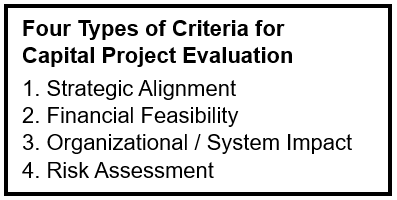 These opportunities may arise with a competitor, in a different economic sector (e.g. retail setting), or with another organization in the human services sector focusing on one or more relevant social determinants. To assess these potential partnerships effectively, revisit the four Project Selection Criteria discussed earlier (see sidebar). Evaluate each opportunity for strategic alignment, financial impact, organizational/system influence, and risk. A well-chosen partnership can enhance project success, expand resources, and create long-term value.
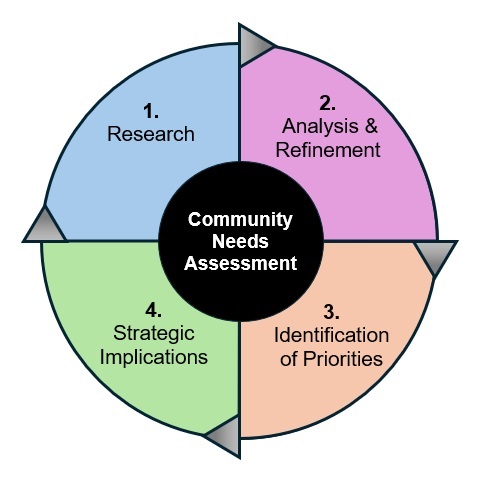 I really enjoy working on Community Needs Assessments (CNAs). For me, it’s the critical starting point on the road to meaningful measurable improvement in the health and wellbeing of all community members. So, you can imagine how excited I was when one of my clients invited me to join them in a Podcast to talk about the CNA that we just completed.
 Welcome to a new year, filled with new opportunities. And what better time to set the stage for success than at the beginning? You’ve probably heard this kind of thinking in one or more quotes (e.g. Well begun is half done – Aristotle). In fact, these first few weeks of the year really are ideal to engage in a couple of key activities that will create momentum and pay dividends through the months ahead. Let’s run through a short list of ways to leverage this perfect timing.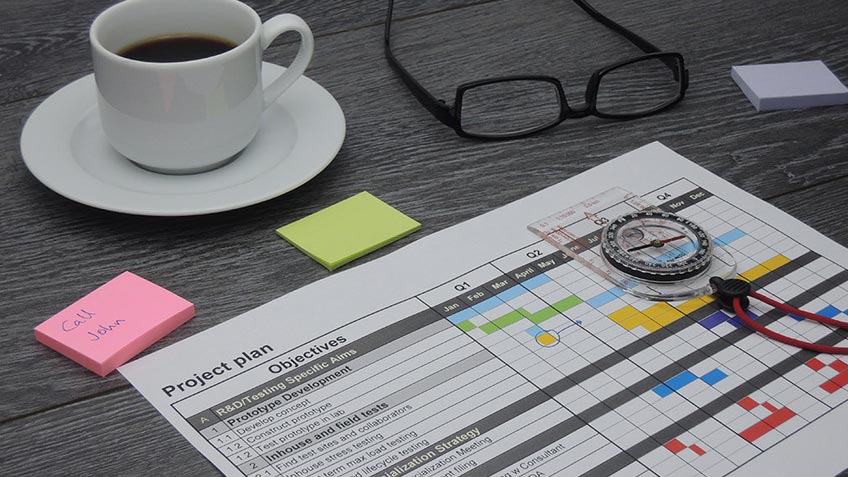
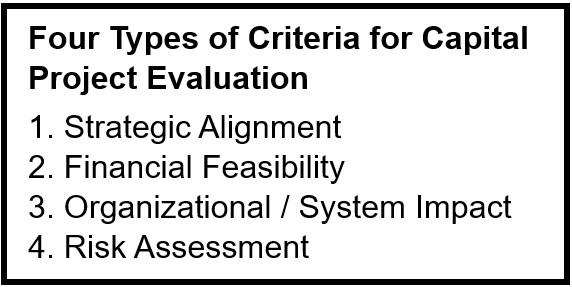 We suggest that there are four major types of criteria, each of which were addressed in previous posts in this series (see sidebar). If the selection criteria deserve extra scrutiny in an era of tight capital, then it stands to reason that implementation and project management also need added focus. And at that stage, it’s all about the details, especially these five.
 As the calendar draws to a close it's a great time to look forward by looking back. What do I mean? You can use data from past performance to identify opportunities for future improvement. And none of this requires a lot of time, which probably sounds especially good during this holiday-infused, busy time of year. Let's take a closer look at several ways to “pay it forward” with your data.
 The concept of a Risk Assessment is not new, however incorporating a few tools and concepts can strengthen the reliability of the assessment. With these tools, the assessment can be more thorough and consider circumstances that might otherwise be overlooked. The fourth criterion, Risk Assessment, is intentionally positioned last so useful data gained from examining the other three can inform the risks to be considered.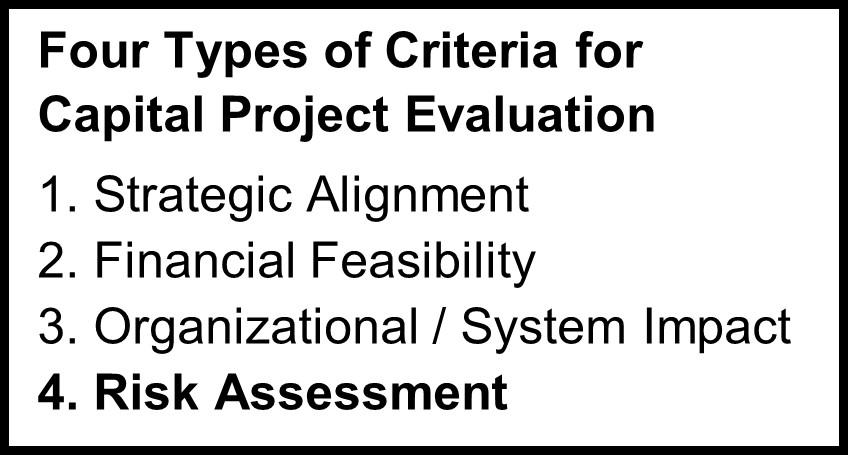
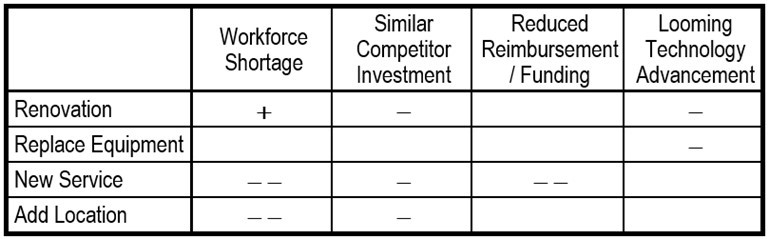 Some scenarios may relate to major trends (e.g. workforce shortage), while others stem from unique circumstances related to one or more of the requests (e.g. a competitor planning a similar investment). Use these as column headers in a matrix, with the various capital proposals as the row headers. Then, use symbols to indicate negative (-) or positive (+) impact that each scenario (column header) would likely have on each capital request (row header), keeping in mind that an empty cell (no impact) is also possible for any scenario/project combination. The completed table (see example at right) gives evaluators another way to compare the risk of the proposals.